Why Houston Roofs Leak: Flashing, Heat, and Humidity Explained
July 31, 2026
Quick Answer: Most roof leaks in Houston homes come from a short list of weak points rather than the shingles themselves. Failed or lifted flashing around chimneys, walls, and valleys is the leading culprit, followed by cracked or missing shingles, worn rubber pipe boots and vent seals, clogged gutters and valleys that back water up under the roof, aging skylight seals, and attic condensation driven by Gulf Coast humidity. Wind, hail, and heavy rain from storm season speed up every one of these failures, which is why a leak that shows up in July often started months earlier.
You walk into the guest room after an afternoon thunderstorm and notice a faint brown ring spreading across the ceiling. It was not there last week. The rain has already stopped, the sun is back out, and the stain is the only clue that something on your roof gave way. That single water spot is rarely the whole story. By the time moisture reaches drywall, it has usually traveled through decking, insulation, and framing, following a path that started at a spot you cannot see from the ground.
Understanding where roofs actually fail helps you spot problems early and describe them accurately when you call for an inspection. Below, we walk through the causes we see most often on Houston-area homes, why our heat, humidity, and storm cycle makes them worse, and what each one looks like from inside your house.
Any area where the roof plane dips, sags, or feels spongy underfoot is not a shingle problem. That is a decking problem, and it means moisture has been sitting on the structural layer long enough to cause rot. A repair over compromised decking will not hold. The deck has to be replaced before anything else gets installed over it.
How a Roof Keeps Water Out (and Where It Fails)
A shingle roof is a layered system, not a single surface. Shingles shed most of the water, but underneath them sit underlayment, flashing at every seam and edge, sealed penetrations for vents and pipes, and a drainage path that moves water into gutters and away from the structure. When every layer does its job, rain runs off in seconds. A leak means one of those layers has a gap, and water only needs a small one.
That is the frustrating part of roof leaks: the failure point and the stain almost never line up. Water enters at a high spot, runs along a rafter or a run of decking, and drips down where gravity decides. We regularly trace a bedroom ceiling stain back to a flashing gap on the opposite side of the roof. Knowing the common entry points is what turns a guessing game into a targeted repair.
Flashing Failures: The Number One Leak Source
Flashing is the thin metal that seals the joints where your roof meets something else, such as a chimney, a dormer wall, a plumbing vent, or the valley where two roof planes come together. These transitions are the hardest places to keep watertight, and they are where we find the majority of leaks.
Flashing fails for a few reasons. The sealant behind it dries out and cracks after years of Houston sun. Fasteners loosen as the roof deck expands and contracts through our wide daily temperature swings. High winds during a storm can bend or lift a section just enough to open a channel. Once water gets behind flashing, it bypasses the shingles entirely and runs straight to the decking.
Chimney and wall flashing
Brick and stucco surfaces move at a different rate than the roof, so the seam between them is under constant stress. Gaps here often show up as stains on an interior wall rather than the ceiling.
Valley flashing
Valleys carry a large volume of runoff during heavy rain. When the metal underneath corrodes or the shingles along the valley wear thin, that concentrated water finds any weakness fast.
Cracked, Curled, and Missing Shingles
Shingles are your first line of defense, and Houston's climate is hard on them. Months of intense summer heat and ultraviolet exposure bake the asphalt, causing shingles to dry out, curl at the edges, and lose the protective granules that shield them from the sun. Once a shingle curls or cracks, wind-driven rain slips underneath.
Granule Loss From Heat and Age
Those tiny sand-like granules on a shingle are not decorative. They protect the asphalt from UV damage. As shingles age, and especially after hail strikes them, granules wash into the gutters. You may notice dark bald patches on the roof or a buildup of grit in the downspouts. Bare asphalt degrades quickly under our sun, and thin spots become leak paths.
Wind Uplift and Torn Tabs
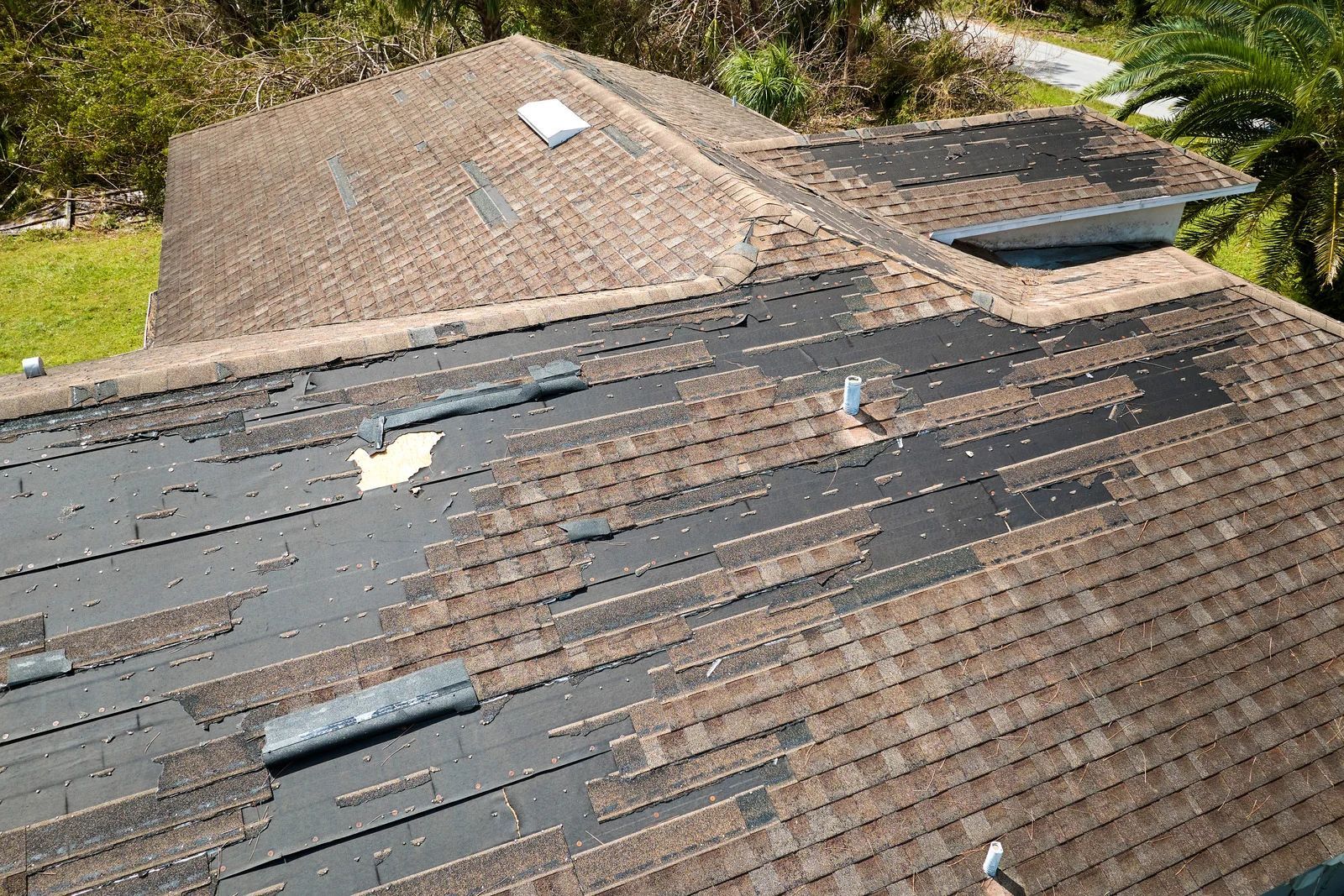
Gulf Coast wind events, from summer squalls to the outer bands of tropical systems, exert lift on shingle edges. Once the adhesive strip breaks, tabs flap and eventually tear off. Even a few missing shingles expose the underlayment and decking to direct rain, and that underlayment was never meant to be the last barrier for long.
Hail Bruising
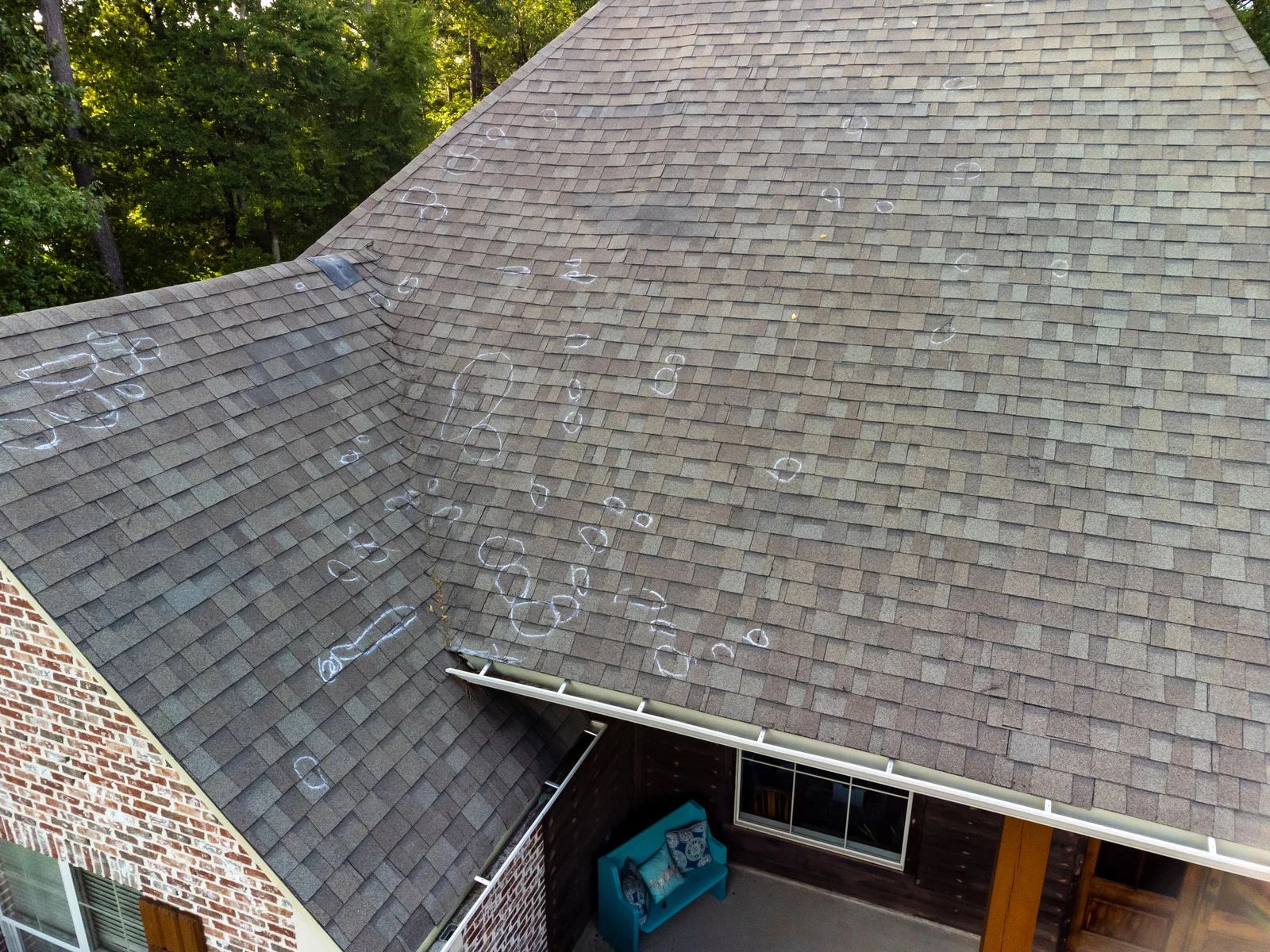
Hail rarely punches a clean hole. Instead it bruises shingles, fracturing the mat beneath the surface and knocking granules loose. The damage can be nearly invisible from the driveway, yet those bruised spots weaken and open up over the following months, which is why a leak sometimes appears long after the storm that caused it.
Worn Pipe Boots and Vent Seals
Every plumbing vent, exhaust fan, and gas flue that pokes through your roof is sealed with a boot or collar, and many of these use a rubber gasket. Rubber is the shortest-lived material on a typical roof. Under relentless Houston heat and UV, gaskets harden, shrink, and crack, often within a decade, well before the shingles themselves wear out.
A failed pipe boot is one of the sneakiest leaks we find because the volume of water is small and the stain shows up directly below the pipe, sometimes mistaken for a plumbing problem. If you have a ceiling stain that appears only during rain and sits near a bathroom or kitchen, a cracked boot is a prime suspect.
Clogged Gutters and Blocked Valleys
Drainage is half of what keeps a roof dry. When gutters fill with leaves, shingle granules, and the pollen and debris our climate produces in abundance, water has nowhere to go. It backs up under the shingle edge along the eave, soaks the decking, and rots the fascia behind the gutter. During the heavy, fast-falling rain typical of a Houston downpour, even a partially blocked gutter can overflow and push water where it does not belong.
Valleys clog the same way. Leaves and debris collect in the channel, form a small dam, and force runoff sideways under the shingles. Because valleys already handle the most water on the roof, a blockage there tends to leak quickly and generously.
Attic Condensation: The Leak That Is Not Rain
Some of the most confusing leaks we investigate have nothing to do with rain at all. Houston's humidity rarely lets up, and when warm, moist air reaches a cooler attic surface, it condenses into water, exactly like a cold glass sweating on a summer day. Poor attic ventilation traps that damp air against the underside of the roof deck, where it drips onto insulation and eventually the ceiling below.
Homeowners often report a stain that appears on humid days or overnight when it has not rained, along with a musty smell and, in bad cases, mold on the rafters. The fix is not a patch on the shingles but a correction to airflow, so that intake and exhaust vents let the attic breathe. In our climate, ventilation is as much a part of a dry roof as the shingles are.
TIP: Twice a year, step into your attic with a flashlight on a dry day and look at the underside of the roof deck. Dark streaks, damp insulation, rusted nail tips, or a musty odor point to a ventilation or condensation problem you can address before it reaches your ceiling.
Skylights, Aging Seals, and Roof Penetrations
Skylights add light and a permanent seam that must stay sealed for the life of the roof. The flashing kit and the gasket around the glass both degrade over time, and the constant expansion and contraction from our heat works them loose. A skylight leak usually shows up as staining on the surrounding ceiling right after rain.
The broader lesson is that anything penetrating the roof, whether a satellite mount, a solar bracket, an old antenna base, or a decommissioned vent, is a potential entry point. Every hole was sealed once, and every seal ages.
Ponding Water and Aging Decking
Low-slope sections over porches, patios, and additions do not drain as fast as steep pitches. When water sits, or ponds, it works at every seam far longer than runoff on a steep roof ever would. Combined with our frequent heavy rain, ponding accelerates wear on flat and low-slope areas.
Age ties all of these causes together. As a roof approaches the end of its service life, the decking can soften, fasteners back out, and the whole system loses its margin for error. A roof that shrugged off storms for years may start leaking in several places at once, not from one dramatic failure but from many small ones reaching their limit together.
When Storms Turn Small Flaws Into Active Leaks
Houston sits in one of the most demanding roofing environments in the country. A single season can bring triple-digit heat, saturating humidity, hail, and the wind and rain of tropical weather. Each of those forces attacks a different layer of the roof, and they compound. Heat bakes and cracks the sealants, hail bruises the shingles and strips granules, and then the next windstorm lifts the weakened tabs and drives rain into every gap the earlier weather opened.
This is why the timeline of a leak can be misleading. The storm that finally sends water through your ceiling is often just the last push against damage that has been building for months. A roof can look intact from the street and still be one gust away from a leak.
WARNING: Do not wait for a visible ceiling stain to take a leak seriously. By the time water reaches drywall, it has usually been wetting the decking, insulation, and framing for a while, and trapped moisture in our humid climate invites rot and mold. A stain the size of a coaster can sit above saturated insulation several feet across.
Frequently Asked Questions
How can I tell where my roof is leaking from the inside?
Follow the water uphill, not down. Trace the stain toward the ridge, since water runs along framing before dripping. Rain-only stains suggest flashing or shingle failure; humid-day stains point to condensation.
Why did my roof start leaking long after the last big storm?
Storm damage is often invisible at first. Hail bruises shingles and wind breaks seals without tearing anything off. Weakened spots hold up briefly, then fail during a later ordinary rain.
Can a roof leak if none of the shingles look damaged?
Yes, often. Flashing gaps, cracked pipe boots, failed skylight seals, clogged valleys, and attic condensation all cause leaks while the shingle field looks fine from the ground. Shingles are just one layer.
Does Houston humidity really cause roof leaks?
Indirectly, yes. Humid air reaching a poorly ventilated attic condenses on the cooler deck and drips down like sweat on a cold glass, mimicking a rain leak, but the cause is trapped moisture.
How often should I have my roof looked at in this climate?
Given our heat, humidity, and storm season, an annual inspection plus a check after significant hail or wind is a sound rhythm, catching worn boots and lifted flashing while still minor
Staying Ahead of Houston's Next Leak
A leaking roof is almost never a single event. It is the moment a long-running weakness finally lets go, whether that weakness is dried-out flashing, a cracked pipe boot, a clogged valley, or an attic that cannot shed our humidity. The homeowners who avoid the worst damage are the ones who learn to read the early signs, a grit-filled gutter, a curled shingle edge, a faint musty smell in the attic, and act while the fix is still small.
With 45
years of experience across Houston, Texas, Sunlite Exteriors
has traced thousands of leaks back to their true source, whether that's a hidden flashing gap, a failed pipe boot, or trapped attic humidity. Every roof here spends its days absorbing heat, storms, and moisture in equal measure, and knowing where that punishment tends to break through is what keeps the water where it belongs, outside and running off, year after year.